Block Finder Records and What They Reveal About a Pool
A pool's block list is the only performance record that cannot be dressed up. Each entry is a block the pool actually found, with a timestamp and a reward, and against a network that mines 144 blocks a day it gives you a testable expectation: a pool holding 1% of hashrate should find about 1.44 blocks daily, one roughly every 16.7 hours. Compare that with what the list shows and you know whether the pool is doing what it claims.

Key takeaways
- 144 blocks are mined network-wide each day, so multiply any pool's network share by 144 to get the block count it should show — a 1% pool expects 1.44 blocks a day, or about 43 in a month.
- Block-to-block gaps are noisy by design: 43 expected blocks in a month carry a standard deviation near 6.6 blocks, so a slow week is usually variance rather than a fault.
- Under PPLNS, payment follows a block and waits for 6 confirmations, using each miner's share of pool hashrate over the last five difficulty rounds — the block list is therefore your payment calendar, not just a scoreboard.
- PPS+ short-circuits this: it settles the block-reward component hourly at a listed 4% fee, so pool luck stops being the miner's problem, which is what the higher listed rate buys.
The core idea
Blockchain data publishes what each block paid and when it was found. Because the network's block interval averages ten minutes, a pool's block list can be read as a series: count the blocks, measure the gaps, and compare both with the expectation implied by the pool's share of total hashrate. Nothing about that needs private access, which is why the record is such a useful filter when evaluating an operator.
The same records explain why payout methods exist. Under PPLNS the pool distributes reward and transaction fees together, at a listed 2% fee, after the block reaches six confirmations and weighted by each miner's contribution across the last five difficulty rounds. That means the block list directly determines when miners get paid, how much, and how bumpy the sequence is. Under PPS+ the block-reward component is settled per accepted share on an hourly basis at a listed 4% fee, and the transaction-fee component follows PPLNS logic at a listed 2% fee, so a dry spell in the block list costs the miner nothing on that first component.[1]
How it plays out at scale
Size changes the character of a block list, not just its length. A pool with 10% of the network hashrate expects 14.4 blocks a day and averages a block every 100 minutes; a pool with 0.5% expects 0.72 blocks a day and averages a block every 33.3 hours. The first list looks like a metronome and the second like a series of isolated events, even though both are generating the same reward per unit of hashrate.
| Record you can read | Value at current network state | What it reveals |
|---|---|---|
| Network blocks per day | 144 | The base rate against which any pool's block count is judged |
| Subsidy per block | 3.125 BTC | The portion of a reward that PPS+ settles per share, and that PPLNS distributes |
| Expected blocks, 1% pool | 1.44 per day, about 43 per month | Whether the pool's published hashrate matches its actual output |
| Expected gap between blocks, 1% pool | 16.7 hours | How long a PPLNS miner may wait between credited blocks |
| Confirmations before distribution | 6, roughly 60 minutes | When a found block turns into a payable balance |
| PPLNS measurement window | The last 5 difficulty rounds, about 70 days | How far back your shares still count toward the next distribution |
| Days needed for 0.1 BTC at 100 TH/s | About 2,227 days | Why small hashrate feels block luck and large hashrate does not |
Two rows in that table deserve more attention than they usually get. The confirmation rule means a block found tonight is not income tonight; under PPLNS the pool waits for six confirmations, which at the ten-minute target is roughly an hour, before it distributes anything. And the five-round window means your shares keep paying out across subsequent blocks for about ten weeks, which is why a PPLNS miner who stops hashing does not stop receiving distributions immediately.
Two scenarios compared
Scenario one: 1 PH/s on PPS+. Settlement is per accepted share against current difficulty, hourly. Daily output is about 0.000449 BTC, or $37.99 at the 21 September 2026 price of 84,692, arriving in steps of roughly 0.0000187 BTC. The pool's block list can run cold for a day and this miner's income does not move, which is precisely the risk the listed 4% fee on the block-reward component covers.
Scenario two: 1 PH/s on PPLNS in a 1% pool. Over a 70-day window this miner should earn about 0.0314 BTC gross at current difficulty, near $2,661.80. Their share of that pool is 0.1% of network hashrate against the pool's 1%, so about one block in ten credited to the pool carries their slice. If the pool's record shows 43 blocks in a month instead of the expected 43.2, nothing is wrong; if it shows 30, that is a 30% shortfall, well outside one standard deviation of about 6.6 blocks, and worth investigating before blaming the market.
Run the same two scenarios through the fee lens. PPS+ lists 4% on the PPS-settled block-reward component and 2% on the transaction-fee component; PPLNS lists 2% on the combined amount. On the 70-day PPLNS figure, the 2% charge holds back roughly $53 less than a 4% charge on the same base — a real advantage that a pool running 25% below its expected block count would erase several times over. That is the trade: a lower listed fee in exchange for carrying pool luck yourself.
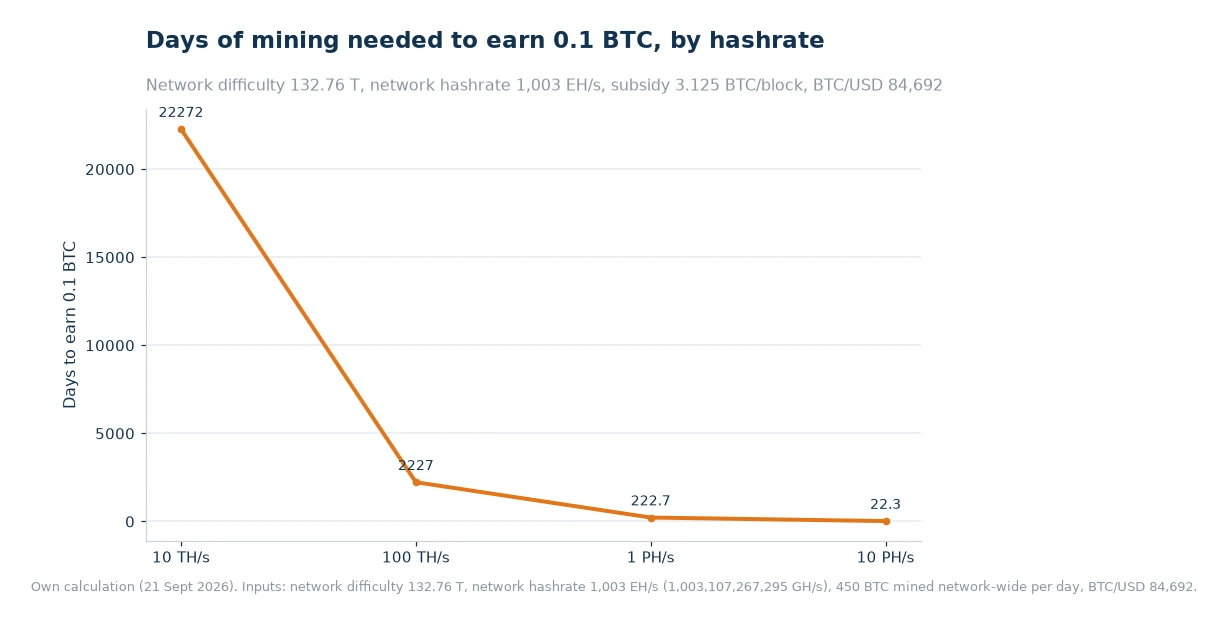
The chart frames the scale question. Ten terahashes needs roughly 22,272 days to produce 0.1 BTC, while 10 PH/s needs about 22 days — a thousandfold difference in time for the same target, and a reminder that block-centred payout methods matter differently depending on which end of that range you sit. For a 10 TH/s machine, one block credited to a small pool is a lottery ticket; for a 10 PH/s farm, it is a routine weekly event, and the pool's record is the thing you audit. Anyone looking at that range of outcomes should be sizing machines against live difficulty rather than memory, which is what a income calculator exists for.
One more check belongs in the same pass: whether the pool's published share is stable. A pool whose share is drifting down will find fewer blocks over time at constant miner hashrate, and the block list will show it before any dashboard does. That is exactly the comparison a mining statistics view lets you run across several coins at once.
Common failure modes
- Reading a short block list as a broken pool. Variance is the mechanism, not a malfunction. Judge a pool over its measurement window, not over a weekend.
- Assuming a big pool is faster per terahash. Your expected BTC depends on your share of network hashrate; the pool's size changes how smoothly that expectation arrives.
- Ignoring the confirmation step. Under PPLNS, a block needs six confirmations before distribution, so a payout can look "missing" when it is only ten minutes old.
- Forgetting that shares expire. PPLNS weights the last five difficulty rounds; capacity that goes offline for weeks stops contributing to future distributions.
- Judging an operator on interface polish. A published hashrate, a difficulty figure and a block list are the three numbers that can be verified independently — the ViaBTC BTC Mining Pool state page is a good example of the three sitting together.
Frequently asked questions
Do mining pools cost anything to join?
Joining is free; the pool earns from its fee on settled payouts, which appears as a percentage of the block-reward and transaction-fee components.
Can I mine more than one coin at the same time?
Yes. Merged mining lets a machine secure a parent chain and an auxiliary chain together, and multi-coin pools support switching between chains without moving hardware.
What should I read first in a block finder record?
The cadence. Compare the number of blocks in the last seven days with 144 multiplied by the pool's network share. If the count tracks within one standard deviation, the pool is doing what its published hashrate implies.
How long after a block is found are PPLNS miners paid?
Distribution follows six confirmations, which is roughly an hour at the ten-minute target, and the split is weighted by each miner's share of pool hashrate across the last five difficulty rounds.
Audit the record, then choose the method
Take the pool's published hashrate, divide it by the network total, multiply by 144, and hold that number against the last month of blocks. If the two agree, the operator is credible and the remaining decision is which risk you prefer: PPS+ with hourly settlement and a higher listed fee on the block-reward component, or PPLNS with the lower combined fee and the pool's luck in your distribution. Either choice is defensible; what is not defensible is picking one without reading the block list that decides how it pays out.
Data and sources: ViaBTC fee schedule and component breakdown[1], ViaBTC mining statistics[2] and ViaBTC income calculator[3]. Network difficulty (132.76 T), network hashrate (1,003 EH/s), the 144 daily blocks at a 3.125 BTC subsidy and the BTC/USD price of 84,692 were read from public chain data and market feeds on 21 September 2026. Every block count, gap, standard deviation and dollar figure is our own calculation from those inputs, shown for illustration only; difficulty and price move, so recheck before acting.