A body mist is the cheapest way to put an existing scent into more hands, and the easiest way to dilute a brand that has not thought it through. Technically the format is straightforward: a much lighter fragrance load, a large pack, a fine spray and packaging that carries the same visual language as the core product. Commercially it is a different product with a different buyer, a different shelf and a different margin. Brands that treat it as a smaller version of the perfume usually end up with a line extension nobody needed.
Key takeaways
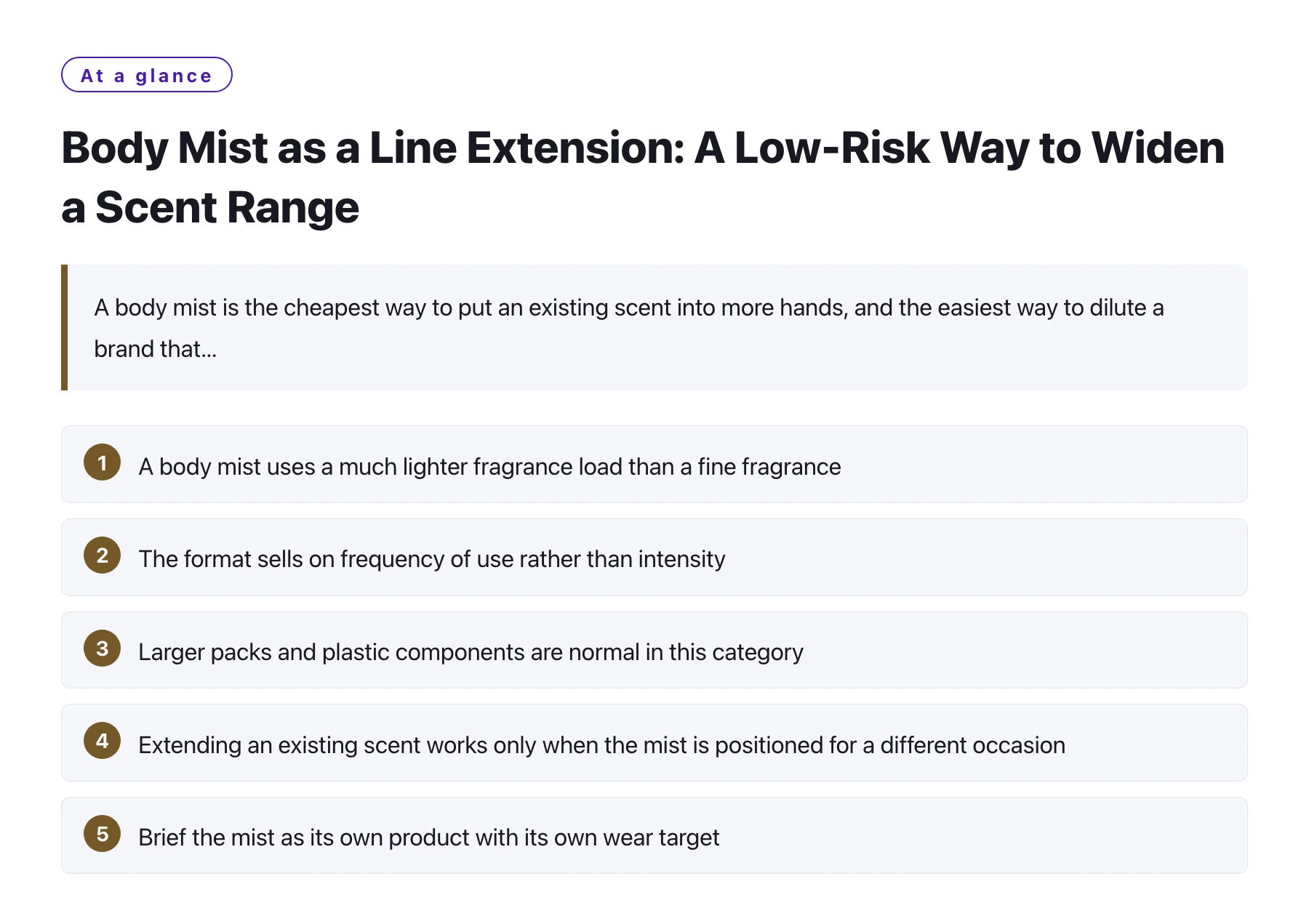
- A body mist uses a much lighter fragrance load than a fine fragrance, which lowers both unit cost and wear time.
- The format sells on frequency of use rather than intensity, so repeat purchase behaviour differs from a perfume.
- Larger packs and plastic components are normal in this category, which changes weight, shipping cost and packaging rules.
- Extending an existing scent works only when the mist is positioned for a different occasion, not as a cheaper substitute.
- Brief the mist as its own product with its own wear target, rather than diluting the original formula.
The scene is familiar. A brand has one scent that sells, a loyal but small customer base, and a gap in the range where a lower-priced entry point should sit. A body mist looks like the answer: same scent, bigger bottle, cheaper shelf price.
It often is the answer, but not for the reasons brands assume. A mist does not simply extend the perfume downward; it moves the product into a different usage pattern, a different retail context and often a different regulatory position on labelling and packaging.
This piece covers what actually changes when a scent goes into a mist, where the format earns its place in a range, and how to brief the project so it adds sales instead of moving them around.
What changes when a scent goes into a mist
The headline difference is fragrance load. Where a fine fragrance might carry a substantial share of fragrance compound, a body mist typically sits in the low single digits, a range long used for light refreshing formats [1]. That single change ripples through cost, wear time and how the product is used.
The second difference is the pack. Mists are usually sold in larger volumes with a fine spray, which means plastic or lightweight glass, a different closure, and a shipping profile that is heavier per unit than a small perfume bottle.
Lower load means a different wear curve
A mist is designed to be reapplied. It opens brightly, sits close, and fades within a few hours. That is not a defect; it is the use case. Positioned as a substitute for a long-wearing eau de parfum it will always disappoint, and the reviews will say so.
The formula still has to be built, not diluted
Dropping the fragrance load of an existing formula is the most common shortcut in this category and usually the wrong one. The materials that carry a fine fragrance through its dry-down are proportionally too heavy in a light format, and the result can read as flat or muddy.
A better brief asks the perfumery team for a mist built around the same signature — the same recognisable opening and character — with its own balance of materials suited to a short wear cycle. It is a smaller development job than a new scent, but it is still a development job.
Labelling and packaging follow the format
Ingredient declaration and allergen wording are driven by what is actually in the finished product, not by the category name, so a mist needs its own documentation even when it shares a scent family with the perfume, and in the European Union the obligation sits with the entity that places the product on the market rather than with whoever blended it [2]. Pack weight and material choice also fall under packaging rules in several markets, and those rules are tightening around what can be placed on the market and what has to be recyclable or refillable [3]. Material choices and design-for-recycling guidance from industry coalitions are a practical starting point when specifying the bottle and closure [4].
None of this is a reason to avoid the format. It is a reason to bring packaging and compliance into the brief at the same time as the scent rather than after the pack is chosen.
Extending a scent into a mist in five moves
- Decide the job the mist doesWrite one sentence on when it is used and by whom. If it is the same occasion as the perfume, the two products will compete.
- Set a wear target, not a dilution ratioAsk for a specific opening, presence and fade profile so the perfumer builds to an outcome rather than a percentage.
- Choose the pack for the channelMass retail, gifting and e-commerce each favour different volumes and closures; decide the channel before the bottle.
- Model the margin on total costA larger, heavier pack can cost more to ship than expected even when the liquid is cheaper. Include freight and duty in the calculation.
- Align the artwork with the core lineThe mist should be recognisable at a glance as part of the range, with a clear cue that it is the lighter format.
- Plan the refill question earlyDeciding whether the pack can be refilled affects material choice and tooling, and it is expensive to retrofit later.
Where a mist earns its place in a range
| Range situation | Does a mist help? | What it must not do |
|---|---|---|
| One strong scent, loyal but narrow audience | Yes — it creates a lower-priced entry and a repeat-purchase habit | Undercut the perfume's price positioning without adding a new use occasion |
| A scent family with several variants | Yes — mists let buyers collect more than one variant at low commitment | Become so numerous that the core line loses its focus |
| Gifting and travel retail | Often — the format travels well and suits sets | Look like a filler item added only to raise the average basket |
| A brand with no scent identity yet | Rarely — there is nothing to extend | Delay the harder work of establishing one signature first |
| Body care already in the range | Yes — washes and lotions give the mist a natural place to sit | Introduce a different scent direction that splits the range |
The pattern in the middle column is consistent: a mist works when it opens a new occasion or a new price point for a scent people already like. It struggles when it is used to fill a visible gap in a price ladder without a reason for a customer to buy both.
Keeping the extension from eating the original
Cannibalisation is the risk brands mention last and experience first. The defence is not pricing the mist badly to protect the perfume; it is making the two products do different jobs.
Differentiate the occasion, not just the price
Perfume for evenings and occasions, mist for after the gym, before bed, or layered through the day. When that distinction is written into the brief and reflected in the artwork, the two products support each other instead of competing for the same purchase.
Give the mist its own reason to be bought twice
The economics of the format depend on frequency of use, so the product must be easy to reapply and pleasant to use repeatedly. A difficult spray, a heavy pack or an unpleasant skin feel after several applications will kill repeat purchase faster than any competitor.
This is also where the format pairs naturally with body care. A wash or lotion in the same signature gives the customer a reason to keep the scent in the bathroom rather than only on the dressing table, and manufacturers that already produce fine fragrance alongside home and scented body products can develop the whole set against one brief. Xuelei, for instance, produces both sides of that portfolio, which makes a mist-and-wash pairing a single development conversation rather than two.
Read the extension as a portfolio decision
For a manufacturer, presenting a range means publishing what formats and categories it actually produces; a brand evaluating a partner can look at how the home and body side of the portfolio is described on Xuelei's official site and judge whether the mist would be developed as a considered format or as an afterthought.
For the brand, the equivalent check is internal. If the mist cannot be given a clear occasion, a clear price point and a clear visual place in the range, it is probably a project to postpone rather than a launch to rush.
The most expensive version of this project is the one where the mist is treated as a formula dilution and a cheaper bottle. It ships quickly, sells once to existing customers, gets reviewed as weak, and takes the perfume's ratings down with it. The cheaper route in the long run is to brief it properly: a short wear target, a pack chosen for the channel, a margin model that includes freight, and artwork that makes the difference between the two products obvious at a glance.
Sources
- Wikipedia: Perfume —— An encyclopaedic overview of perfume covering definitions, history, the note structure of a fragrance and concentration terminology (background reference only).
- European Commission: Cosmetics in the EU —— The European Commission's overview of EU cosmetics rules, including the responsible person, product information file and safety report requirements.
- European Commission: Packaging Waste and the PPWR —— EU rules on packaging and packaging waste, including the Packaging and Packaging Waste Regulation requirements on recyclability and design.
- Sustainable Packaging Coalition —— A membership organisation working on more sustainable packaging design, publishing material and recyclability guidance.
Frequently asked questions
How much fragrance oil is in a body mist?
Body mists typically carry a low single-digit percentage of fragrance compound, far below a fine fragrance. The exact figure depends on the brief and the intended wear time. It is better to specify the wear profile you want and let the perfumer choose the load than to fix a percentage in advance.
Can a brand simply dilute an existing perfume formula into a mist?
It is possible but usually a mistake. Reducing the load of a formula built for long wear leaves the heavier materials out of proportion, and the result can smell flat or unbalanced. A better approach keeps the same signature but rebuilds the balance for a short wear cycle.
Does a body mist need its own compliance documentation?
Yes. Ingredient declarations, allergen wording and safety documentation describe the finished product, not the scent family, so a mist needs its own set even when it shares a signature with the perfume. Packaging rules may also apply differently because of the larger pack.
Will a body mist reduce sales of the main perfume?
It can, if the two products target the same occasion at different prices. When the mist is positioned for a different moment in the day and carries artwork that makes the difference clear, it tends to bring new customers into the range rather than move existing perfume buyers down.
What pack size works best for a body mist?
It depends on the channel. Gifting and travel favour smaller, lighter formats; daily-use retail and body care ranges often suit larger ones. Whatever the volume, confirm the spray quality, the closure and the shipping weight before approving the pack, because those details decide whether customers actually reapply.