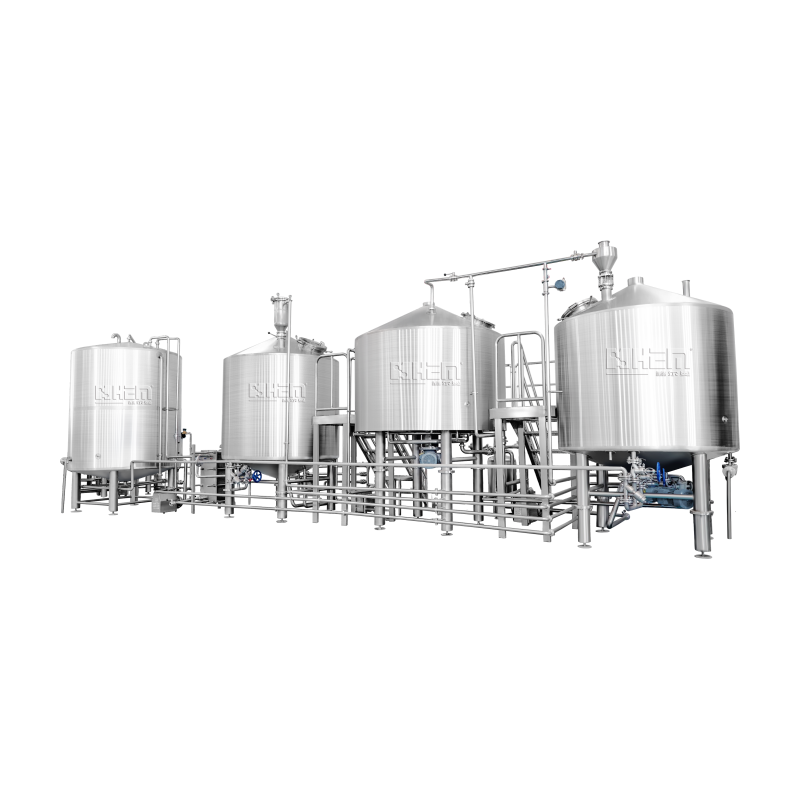
Modern brewing equipment combines precise temperature control, sanitary stainless-steel construction, pressure-rated fermentation, automated liquid handling, efficient heat exchange, and clean-in-place systems. A commercial mash commonly operates around 63–68°C, wort boils near 100°C at sea level, and fermentation may range from about 8°C for lagers to more than 20°C for some ales. Modern fermenters often use multiple glycol-cooled zones, while variable-frequency pumps regulate flow without constant manual valve adjustment. The equipment matters most when temperature, pressure, flow, cleaning, and utility use can be measured and repeated from one batch to the next. Water, electricity, heating, labor, and cellar capacity all affect real production efficiency.
Most breweries begin with stainless-steel vessels because the material tolerates acidic beer, alkaline cleaning chemicals, repeated heating cycles, and years of wet service. Type 304 stainless steel is widely used for tanks, piping, and brewhouse surfaces; Type 316 may be selected where greater corrosion resistance is required. Product-contact welds should be smooth, accessible, and free from crevices that retain wort or cleaning solution. A vessel made from good steel but finished with poor welds can still be difficult to sanitize.
Material quality leads directly to vessel geometry. Mash tuns need enough free volume above the grain bed to handle mixing and recirculation, while lauter tuns require a false bottom that supports grain without creating excessive flow resistance. Commercial mash rests commonly fall between 63°C and 68°C, and changing only 2–3°C can noticeably change fermentability because alpha- and beta-amylase do not perform identically across that range. Automated steam jackets or electric heating elements can hold programmed steps more closely than manual burner control.
That temperature accuracy becomes useful only when liquid moves through the system at a controlled rate. Modern pumps are commonly fitted with variable-frequency drives, allowing motor speed to change instead of forcing operators to throttle every transfer mechanically. During lautering, excessive draw-off can compact the grain bed and slow extraction, while excessively slow transfer reduces brewhouse throughput. A brewery producing 4 batches during an 8–10 hour brewing day cannot afford an extra 30 minutes at every transfer point.
Brewhouse throughput also depends on how efficiently the kettle delivers heat. Steam jackets remain common in larger systems because they spread heat across a broad vessel surface, while electric elements are often practical in smaller installations. Wort is normally boiled for roughly 60–90 minutes, although recipe design, evaporation rate, kettle geometry, hop use, and altitude can change the requirement. Evaporation rates around 4–10% per hour are common operating ranges rather than universal targets.
Higher heating power does not automatically produce better wort. The kettle needs enough energy for stable boiling and volatile removal without excessive evaporation, scorching, or unnecessary steam consumption.
Once boiling ends, the next equipment task is separating solids before cooling. Whirlpool vessels introduce wort tangentially so rotational flow helps collect hop material and protein solids near the center. Residence times often sit around 10–30 minutes depending on vessel size and recipe. The clearer outer portion of the wort can then move toward the heat exchanger, reducing the amount of heavy solids entering downstream piping and fermentation equipment.
Cooling is one of the largest thermal changes in the entire process. Wort may leave the kettle near 100°C and enter an ale fermenter around 18–22°C or a lager fermenter near 8–14°C. Plate heat exchangers place thin metal plates between hot wort and colder water or glycol circuits, creating a large heat-transfer area inside a compact unit. Proper sizing depends on wort flow, coolant temperature, inlet temperature, required outlet temperature, and allowable pressure drop.
The hot water leaving the exchanger can be useful elsewhere. Instead of sending that heat to drain, many breweries collect warmed water in a hot-liquor tank for the next mash, sparge, or approved cleaning step. Brewers Association guidance has reported average brewery water use around 7 barrels of water per barrel of beer, while efficient operations can operate below 3:1. Older benchmarking data also showed a median of about 4.5 barrels of water per barrel of beer among participating breweries producing more than 100,000 barrels annually.
Water use is closely connected with cleaning design. A clean-in-place system circulates water and chemicals through tanks and piping without dismantling the entire process line. A sequence may include an initial rinse, alkaline wash, intermediate rinse, acid treatment when required, and sanitizing stage. Caustic solutions are often used at roughly 1–2% concentration, although actual concentration, temperature, contact time, soil level, and chemical supplier instructions determine the correct program.
Cleaning also depends on mechanical force. Spray balls, rotary jets, pump flow, pipe velocity, and drain position influence whether cleaning solution reaches the full product-contact surface. A tank can receive 20 minutes of chemical circulation and still remain poorly cleaned if the flow pattern misses the upper wall or leaves stagnant sections in piping. Modern sanitary layouts therefore reduce unnecessary dead legs and use sloped pipework where drainage requirements call for it.
CIP performance is a combination of chemical concentration, temperature, time, and mechanical contact. Increasing only one variable cannot compensate indefinitely for poor equipment geometry.
After cleaning, fermentation places different demands on the equipment. Cylindroconical fermenters typically combine a vertical cylindrical body with a conical base, often between roughly 60° and 70° depending on design. Yeast and sediment collect toward the bottom, allowing brewers to remove settled material through dedicated ports instead of transferring the entire beer into another vessel immediately after fermentation.
Temperature control becomes more demanding as vessel volume increases. Yeast generates heat during active fermentation, so a 5-barrel tank and a 100-barrel tank cannot be treated as thermally identical even when the recipe is the same. Larger fermenters commonly use several independent glycol-jacket zones. A controller reads the tank temperature and opens a glycol valve when the beer rises above the programmed setpoint, often maintaining fermentation within roughly 0.5–1.0°C when the refrigeration system is properly sized.
Pressure adds another engineering requirement. Some unitanks are designed for fermentation, conditioning, carbonation, and serving preparation inside one vessel, but allowable pressure must come from the vessel rating rather than operator preference. Working pressures around 1–2 bar are common in many brewery applications, while exact limits vary by tank. ASME's 2025 Boiler and Pressure Vessel Code includes requirements covering pressure-vessel design, construction, inspection, and certification, so pressure capability must be treated as an engineering specification rather than a marketing number.
That pressure control also affects carbonation and beer handling. Carbon dioxide dissolves more readily at lower temperatures and higher pressure, which is why beer may be cooled close to 0–4°C before final carbonation or packaging. Pressure gauges, relief valves, vacuum protection, sample ports, carbonation stones, and sanitary manways all become functional parts of the cellar rather than optional accessories.
| Process area | Typical operating range | Equipment feature that controls it |
|---|---|---|
| Mash | 63–68°C | Jacket heating, agitator, temperature probe |
| Wort boil | About 100°C at sea level | Steam jacket or electric heating |
| Ale fermentation | About 18–22°C | Glycol jacket and controller |
| Lager fermentation | About 8–14°C | Multi-zone glycol cooling |
| Cold conditioning | About 0–4°C | Refrigeration and insulated tank |
| CIP caustic | Often around 1–2% | Chemical dosing and circulation system |
With the cellar stabilized, automation determines how consistently the brewery can repeat the sequence. Modern controls may connect temperature probes, flow meters, load cells, level sensors, pumps, steam valves, glycol valves, and motorized process valves to a PLC and human-machine interface. An operator can store mash steps, transfer sequences, cleaning programs, and alarm limits instead of reconstructing each procedure manually for every batch.
Automation is especially useful when production grows. A 10-barrel brewhouse producing one batch per day has a different labor requirement from the same system running 3–4 turns. Automated water filling, mash temperature steps, pump-speed control, and transfer routing can reduce repeated manual adjustments, although sensors still require calibration and valves still require inspection. In 2016 Brewers Association benchmarking, breweries producing under 1,000 barrels annually reported a median electricity use of 182 kWh per barrel among 13 participating breweries, illustrating how inefficient small-scale operation can become when utilities and equipment are poorly matched.
Equipment sizing therefore needs to extend beyond brewhouse volume. A 20-barrel brewhouse paired with only two 20-barrel fermenters will stop brewing quickly because fermentation occupies vessels for days or weeks while wort production takes hours. Ten fermenters at the same size provide a very different production schedule even though the brewhouse itself has not changed. Cooling capacity, hot-water storage, steam generation, floor drainage, compressed air, CO₂ supply, and packaging speed must grow with cellar capacity.
A buyer comparing commercial brewery equipment should therefore check usable vessel volume, total volume, heating area, cooling-jacket area, pump curves, motor ratings, heat-exchanger capacity, pressure rating, insulation thickness, fitting standards, control architecture, spare-part availability, and cleaning access. Two 30-barrel systems can have the same nominal batch size while differing substantially in heating time, lautering speed, cooling performance, labor requirement, and daily batch capacity.
Energy data should be reviewed in the same way. Pumps running continuously at full speed can consume more electricity than units controlled by variable-frequency drives, while poorly insulated hot-liquor tanks lose heat between production cycles. Refrigeration systems also work harder when cold tanks, glycol lines, or cellar piping are inadequately insulated. Even a 10% reduction in unnecessary pump, heating, or refrigeration demand becomes significant when equipment runs for thousands of hours each year.
Maintenance access finishes the equipment picture. Mechanical seals, pump impellers, valve seats, temperature probes, pressure transmitters, gaskets, heating elements, steam traps, and refrigeration components are service items. A brewery that cannot replace a common seal or sensor quickly may lose an entire production day over a small component. Modern equipment performs well when its capacity, utilities, sanitation, control system, and service requirements are designed as one production system rather than purchased as isolated tanks.