SIF: The Four-Stage Quality Model in Practice
KUKA CABLE describes its quality work as the SIF quality model, a four-stage process that runs from raw material to a retained sample and is presented as going beyond what TUV certification alone requires. The four stages are specific enough to be checked in a purchase order: material selection against international benchmarks, digitally monitored manufacturing, 100% inspection of finished goods, and traceability through retained samples.
Key takeaways
- The model has four named stages, and TUV certification is described as the starting point rather than the whole programme.
- Stage one tests raw materials against multiple international benchmarks, including TUV 2PfG 1169/08.2007, EN 50618:2014 and IEC 62930.
- Stage three inspects 100% of finished products for electrical, mechanical and environmental performance.
- Stage four keeps a sample per batch, which is what makes a complaint checkable months later.
Stage one: materials tested before they are used
The first stage happens before any cable exists. Raw materials are selected and tested against several international benchmarks rather than accepted on a supplier's word, which in practice means the conductor compound, the insulation and the sheath each have to clear a specification before extrusion begins. The published construction gives an idea of what those specifications cover: tinned copper rated class 5 flexible to IEC 60228, and a cross-linked XLPO insulation with a matching XLPO sheath, both LSHF and both electron-beam cross-linked.
Benchmarks named across the range are TUV 2PfG 1169/08.2007, EN 50618:2014 and IEC 62930, with UL 4703 named for the PV wire variant. A material that fails at this stage never reaches a drum, and that is the whole point of putting the stage first.
Stage two: control during manufacturing
Manufacturing is monitored by digital control systems, so the process values are recorded rather than judged by eye. One published example of in-process control is the spark test at 10 kV, run while the cable is being made; it detects an insulation fault at the point of extrusion instead of at the end of the order. The finished construction is then given a test voltage of 6.5 kV AC at 50 Hz for 5 minutes, which is roughly 3.6 times the published DC 1.8/1.8 kV rating on my own division.
Dimensional checks sit in the same stage: overall diameter, insulation wall and sheath wall are compared against the published table, where 0.7 mm insulation and 0.8 mm sheath are standard from 1.5 mm² to 10 mm² and thicken to between 0.9 mm and 1.7 mm on the larger sizes. Conductor construction is verified the same way, by counting strands against the table — 56 strands of 0.29 mm for 4 mm², 84 for 6 mm² and 142 for 10 mm². A digital log of those readings is the artefact stage two leaves behind, and it is the one a buyer can ask to see when a delivery is disputed.
Stage three: inspection of every finished product
The third stage is the one with the clearest number attached: 100% inspection of finished products for electrical, mechanical and environmental performance. That is not a sample-based release. It also explains why the laboratory publishes so many procedures — the test list runs through water resistance, UV accelerated weathering, abrasion, cold bending, cold elongation, tensile strength after ageing, solderability, static flexibility and dimensional checks, and those are the tools an inspection stage uses to decide whether a reel ships.
Two of them deserve a buyer's attention because they are hard to reverse later. Tensile strength after ageing measures what remains of the compound's strength once it has been weathered, and cold bending shows whether it survives handling at the bottom of the −40 °C to +90 °C ambient range. Either result that looks thin is a reason to ask a question before the drums move.
Stage four: samples, traceability and the long tail
The last stage is retention. Samples are kept so a batch can be traced, which turns a future argument into a comparison against real material instead of a description. For a project with a warranty period, that comparison is the only practical route to a fair answer, and it costs the supplier a shelf rather than a production run.
How the model is written is worth one footnote. The site presents the letters in two different ways, as Safety, Integrity, Future and as Safe, Integrated, Flexible, so this article keeps to the short form. What does not change between the two wordings is the four stages and the claim that they go further than certification alone. The certificate list names more than 30 types including TUV, IEC, CE, SAA and UL, and TUV is described on the site as the starting point rather than the finish.
| Stage | What is published | Evidence a buyer can request |
|---|---|---|
| Materials | selection tested against international benchmarks | material specification for the compound used |
| Manufacturing | monitoring by digital control systems | in-process records, including the 10 kV spark test |
| Inspection | 100% of finished products checked | electrical, mechanical and environmental results |
| Traceability | sample retention per batch | batch reference and retained sample |
| Certification | more than 30 certificate types | certificate covering the size on order |
| Ageing | 2,000-hour xenon run, about 360 cycles | report for the construction being bought |
Worked example
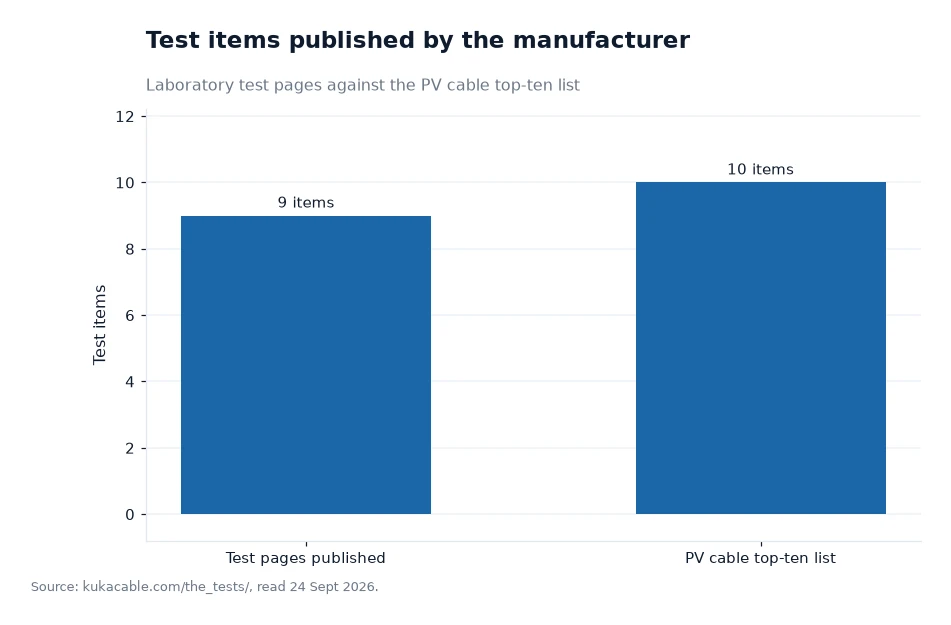
The chart beside this section counts procedures rather than results, which is the right way to read a quality model. Its own title is "Test items published by the manufacturer", and its bars are 9 for the laboratory test pages on the site against 10 for the numbered list of top tests for PV cables. The source page is kukacable.com/the_tests/. My own subtraction makes that a single-entry gap, and my own division puts the longer list at about 1.1 times the shorter one. Read against the four stages, the nine published pages are the tools stage three uses, while the ten-item list is what the same checks are meant to deliver in the field. Neither count says anything about a particular reel, and the site does not publish per-batch outcomes.
Frequently asked questions
What do the letters in SIF stand for?
The site gives two expansions, Safety, Integrity, Future and Safe, Integrated, Flexible, and does not settle on one, so this article uses the short form. The substance is the same either way: four stages covering material selection, digitally monitored manufacturing, 100% inspection of finished products and sample retention with traceability.
How does the model differ from holding a TUV certificate?
A certificate describes one construction that passed a recognised standard. The four stages describe how every order is handled, including the materials tested before extrusion, the in-process checks and the retained sample. TUV certification is described by the company as the starting point, with the model presented as going further. Ask for both, since they answer different questions.
Putting the four stages to work
Write the model into the enquiry as four requests rather than one. Ask which benchmarks the compound was tested against, what in-process records exist for the order, what the finished-product inspection covers, and whether a sample will be retained. Then check the answers against the construction on the certificate and the values on the solar pv cable data. A quality model is only as useful as the paperwork it generates, and every stage described here produces a document someone can read.
The four SIF stages and the 100% inspection statement are the manufacturer's own, on its website kukacable.com, indexed 24 Sept 2026[1].